Saturday, August 16, 2014

The first moment of area equals the summation of area times distance to an axis [Σ(a x r)]. It is a measure of the distribution of the area of a shape in relationship to an axis. 
First moment of area is commonly used in engineering applications to determine the centroid of an object or the statical moment of area. 


b) The second moment of area, also known as the area moment of inertia or second moment of inertia, is a property of a shape that is used to predict its resistance to bending and deflection which are directly proportional.

second moment of area= Ar^2 

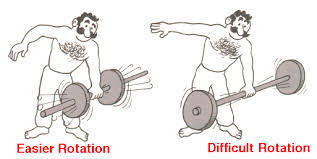
c) Mass moment of inertia or the angular mass, is the rotational analog of mass. That is, it is the inertia of a rigid rotating body with respect to its rotation. 

Here, its again the very old discussion. The above part is second moment of area. Here, its of mass. 

Mass Moment of inetia = mr^2
-PROFESSOR  PRADEEP KARNA

MOMENT OF INERTIA

this picture contains follwing scene. Diagram of a beam on its narrow edge supported at both ends. A man is walking on the straight beam. Diagram of a beam resting on its flat side supported at both ends. A man is walking on the straight beam and it is bending in the middle.  what does this diagram say to you????
ans: by changing the orientation of the beam ,bending of the beam can be avoided.Excess bending causes failure in order to use a number value for describing the bending of a particular geometry second moment of inertia is used.It is denoted by "I"

stress????

SIMPLE STRESS

STRESS is the intensity of force inside a solid. The basic unit of stress is the Pascal (Pa) which is Newton per square metre. In engineering it is more convenient to measured as the force (N) per square mm. This gives the common engineering unit of stress, MPa.

Tensile, Compressive and Shear stress

There are 3 types of stress in the world;
  • Tensile = pulling apart
  • Compressive = squashing together
  • Shear = sliding apart
Any of these 3 types of stress are calculated the same way, with the same units - it the area that is different. Always think of what area must be broken when the component fails (the broken area).

What is a Stress?

STRESS is the intensity of force inside a solid.
It has the same units as Pressure (Pa, kPa, MPa, etc), so you could think of stress as pressure in a solid. The difference is, pressure acts equally in every direction, but stress has a certain direction.
Stress = Force/Area
The base unit for pressure and stress is the Pascal (Pa), but this is way too small for engineering use - except perhaps when measuring the pressure of air conditioning ducts or something. Certainly nothing compared to the stress required to break steel. In most engineering situations, the strength of a material is measured in MPa (MegaPascals)
Stress (MPa) = Force (N) / Area (mm2)
DEFINE FormulaUnitsDiagram
Axial Stress (Tension or Compression) Stress = Force / AreaMPa
Axial Strain (Tension or Compression) Strain = extension / original Length-
Shear StressStress = Force / AreaMPa
Modulus of Elasticity (Young's Mod)E = Stress / StrainGPaSlope of Stress:Strain diagram
Modulus of Rigidity (Shear Mod.) =~ 0.4EG = S. Stress / S. StrainGPaSlope of S.Stress:S.Strain diagram
Shear StrainStrain = movement / original Depth-
Shear in Detail:
Shear Strain is usually small enough to ignore the changes in L with angle. 
Angle is in radians.
Area is the zone that would slide apart  assuming it broke in shear.

Sunday, August 10, 2014

what is quassi static process?????


Quasi means almost or near to. Quasi–Static process means very nearly static process. Let us consider a system of gas contained in cylinder. The gas held by a moving piston. A weight W is placed over the piston. Due to the weight , the gas in cylinder is compressed. After the gas reaches equilibrium, the properties of gas are denoted by p1, v1, t1. The weight placed over the piston is balanced by upward force exerted by the gas. If the weight is removed, then there will be unbalanced force between the system and the surroundings. The gas under pressure will expand and push the piston upward till it touches the stops. The properties at this state after reaching equilibrium are p2,v2,t2. But the intermediate states passed through by the system are non-equilibrium states which cannot be described by thermodynamic coordinates. In this case we only have initial and final states and do not have a path connecting them.

Suppose, the weight is made of large numbers of small weights. And one by one each of these small weights are removed and allowed the system to reach an equilibrium state. Then we have intermediate equilibrium states and the path described by these sates will not deviate much from the thermodynamic equilibrium state. Such a process, which is the locus of all the intermediate points passed by the system is known as Quasi-static process. It means, this process is almost near to the thermodynamically equilibrium process. Infinite slowness is the characteristic feature of quasi-static process.


Thursday, August 7, 2014

exergy anergy entropy

Ask a number of people what they assume energy is. You will have as much different answers as the number of people. So, what is energy? Well, -energy is the capacity to do work- and this is available in a lot of different forms, p.e. electrical, chemical, potential, etc. However not all energy available can be transformed into work. Only a part of it can. Why is this so? Consider therefore a heat source of some kind. This heat can be used to do work and will cool down in doing so. However it can only do this until the temperature is equal to the surrounding, not to a lower value because you would need work in getting the temperature back up. The work obtained from the heat source until the temperature of the surroundings is the amount of exergy. This is a smaller value than the energy what was available in the beginning and the difference is the anergy, the part which is unusable. So in short: energy=exergy+anergy, with exergy the usefull part and anergy the unusable part.

In the process of transforming one kind of energy into the other we have an exergy loss. This means that during the process some exergy is lost and is transformed into anergy. Assume as a simple example that you have 100J energy of which is 80J exergy and 20J anergy in the beginning. After transforming this energy to another form of energy you still have 100J at the end, but only 40J of exergy and 60J of anergy. This means that 40J of exergy is transformed into anergy. A part of the usefull energy is tranformed into unusable anergy. The fact that the energy is constant is nothing more than the first law of thermodynamics. The loss in exergy is a manifestation of the second law. The fact that there is some amount of anergy in p.e. a heat source is the reason why we can't use the energy in the sea, it is all anergy, at least to some extent. To what temperature must we cool it down, it has allready the temperature of the surrounding? A mistake often made. There is energy which is (almost) completely transformable into work meaning that is has no anergy, this is electrical energy, work itself is also exergy.

Exergy and anergy are related to entropy, the amount of entropy rise is related to the loss of exergy. That's one reason why understanding entropy is so important. Be carefull in using this, the entropy can drop in a part of a system, but must always rise for the complete system, often the surroundings entropy rises more than the drop of the system's part.

Saturday, August 2, 2014

first law and second law of thermodynamics

The Conservation of Energy and the First Law of Thermodynamics 

Our changeable friend energy, with its multiple "personalities", is sometimes hard to keep track of and even harder to define. But it does always behave in predictable ways. This means that if you know the rules you, like engineers and scientists, can often predict what will happen and what won't happen.

Smart scientists and engineers, through clever experiments and even cleverer thinking, figured them out in days gone by. It took some open-minded creative thinking. It was not obvious to anyone back then. And much of what was obvious back then about energy was wrong. 


This section is on the First Law of Thermodynamics, or the Conservation of Energy as it is often called. To start, let's remind ourselves of a few things.


A Few things to remember:

Energy can be stored.

Energy can move from one bunch or piece of matter to another bunch or piece of matter.

Energy can be transformed from one type of energy to another type of energy.
Energy conversion in a wind turbine
A wind turbine converts some, not all, of the kinetic energyin the wind into mechanical and electrical energy. The First Law of Thermodynamics says the sum of the energy put into the wind turbine plus the remaining energy in the air after it passes through the turbine, must exactly equal the energy in the wind before it entered the turbine.
The First Law:
During all this moving and transforming the total amount of energy never changes.

That's it! I've done it!
That's the first law of thermodynamics! Ta da!
Energy changes form and moves from place to place but the total amount doesn't change.
Simple, eh?
Even dancing bears must conserve energy.Other ways to say it:
It's conservation of energy. Energy is conserved during any and every process or transformation or "happening".
Energy doesn't pop into existence from nowhere.
Energy doesn't pop out of existence into nowhere.
Energy is neither created nor destroyed (the old fuddy duddy way of saying it).
"Energy in" equals "energy stored" plus "energy out"
(if no energy is stored, then "Energy in" equals "Energy out").

You may have already heard that the 1st Law says energy is "always conserved". So why are we always saying we need to conserve more energy if it is "always conserved" already? Darn old english language, same word but different meanings. When we say energy is always conserved we mean the total amount of energy in any process or reaction never changes. When we tell ourselves to conserve energy we mean to use less of it by doing things like driving more fuel efficient cars, or insulating our houses better.

Engine Energy BalanceBut hold on, if energy never goes away, if the total amount always stays the same, why do we have to worry about not wasting it? Can't we just keep reusing it? We don't really "use" energy, we convert it, and it never "get's used up".

It's not a stupid question. It's a very good question. Unfortunately, the First Law of Thermo doesn't really answer it. The popular first law just says the total amount of energy doesn't change.

Scientists and Engineers had to discover a second law of thermodynamics to answer questions like those above. This section is only on the first law but you can jump to the Second Law page now for a very good explanation of the gist of that law, or continue on to the fascinating next page for some good examples to further clarify the First Law. I hope you will read all the pages, for the sake of my fragile ego.

Conversion of work to thermal energy.On page two of this section we'll give some examples of the results of the conservation of energy. Click on the Next Page link below. 


Energy is Conserved but Not Its Usefulness
As we said above, the first law of thermodynamics says the total amount of energy never changes, even after many changes. It doesn't answer questions like "why can't we re-use the energy over and over again?" or "where do my son's guitar picks go?"

Alas, the second law does answer the questions about re-using energy (not the one's about missing guitar picks and socks though, those mysteries are still beyond the realm of science).

The Second Law is not as easy to say as the first law. It can't be described in one or two sentences. We can't cover it all here, but we can give a brief answer to the questions above. The second law deals with the availability or useability of energy. The unhappy truth is that as energy gets used or transformed in machines or living animals it gets converted into a form that is less useful than before. Something in the energy does get "used up" or even "destroyed". That something is what you might call "usefulness" or as it is often called in thermodynamics, "availability". The energy becomes less available for us to use.

In engines, like those in cars, trucks, locomotives, and airplanes, the energy in the fuel is highly concentrated, meaning there is a lot of energy in a fairly small light package. Each gallon of gasoline (petrol for those of you in other lands) or diesel fuel or jet fuel contains a lot of concentrated easy to use energy. Once that fuel is burned in the engines we are all so dependant on, it gets converted into highly concentrated thermal energy (high temperature) and mechanical energy. The mechanical energy is used to do useful work for us like moving people or freight from one place to another. But eventually all of the fuel's concentrated useful energy get's changed into "low grade" thermal energy. Most is converted immediately into "heat" and goes out of the engine in the cooling water or the engine's hot exhaust gas. The useful mechanical energy gets turned into heat through friction of moving parts or by pushing air molecules out of the way. The molecules that get pushed out of the way absorb the energy of the car or train as increased kinetic energy of the air molecules.

All of the fuel's formerly concentrated "high grade" energy, becomes what we engineer's call "low grade" energy or "waste" heat. We call it that because it is no longer useful to us. It's there, but it's sort of messy and all spread out now, to "gather it up" would take more energy than it's worth. To reuse that low grade energy is simply impossible or would be too expensive and impractical to contemplate. So there it goes, all absorbed into the air and the objects around us as low temperature low grade energy which will finally radiate into outer space to help warm up the universe a tiny little bit. We have to replenish it by burning more fuel. If the fuel is what we call fossil fuel it will eventually all be gone, along with all of its cheap easy to use energy.

Since we haven't yet figured out how to use other forms of energy or alternative fuels as well yet, and those alternatives are likely to be more expensive, most of us think it should not be wasted. That's why we talk about the need to conserve energy. The first law tells us that energy is forever and the total amount stays the same. The second law tells us that "high grade" useful energy always gets turned into "low grade" less useful energy that is difficult or impossible to re-use.

The same is true of the energy conversions in living organisms. The food you eat eventually gets converted into heat (thermal energy) and mechanical work. The heat is useful for a little while to help keep your body temperature constant. The mechanical work is used to make more cells, to breathe, think, run, grow, etc. But in the end, just like with our human made machines, all of the concentrated high grade food energy gets converted into low grade energy we can't reuse. All of it eventually ends up as thermal energy (often called heat) spread out into our surroundings. This also ends up getting radiated into space. And, as you know if you've read the photosynthesis pages, we would run out of useful energy for life very quickly if it didn't get replenished every day by a fresh dose of concentrated energy from the sun.
Back to Where You Were   
            * * source: http://www.ftexploring.com/energy/first-law.html

Factor of safety is just a ratio which gives how much max load a body can withstand without any failure

Thursday, July 31, 2014

Tuesday, July 29, 2014

Momentum in Physics


"When you try to balance an object, if the point of support, the pivot point, is not at the center of gravity then the object will rotate either clockwise or anti-clockwise depending on which side has more torque. However, if the pivot point is on the same vertical line as the center of gravity, then the object, no matter what shape, is going to balance. It will be stable if the center of gravity lies below the pivot point. If the center of gravity is above the pivot point, even a slight disturbance will pull it off balance. In our case if you want to have a stable situation, the center of gravity of this assembly has to be below the pivot point. The pivot point is where the toothpick rests on the rim of the glass. The actual center of gravity must lie in the empty space between the two forks and below the pivot point to achieve stability."

Balance Magic | Design Squad

Sunday, July 27, 2014

What is engineering: How different disciplines work together to create a...

moment

MOMENTS


A MOMENT is the turning affect of a force, commonly known as Torque.  
Lecture Notes:  Moments.pdf    Moments.one

1. Moment Definition

The Moment of a force is the turning effect about a pivot point. To develop a moment, the force must act upon the body to attempt to rotate it. A moment is can occur when forces are equal and opposite but not directly in line with each other.

The Moment of a force acting about a point or axis is found by multiplying the Force (F) by the perpendicular distance from the axis (d), called the lever arm. 
Moment = Force x Perpendicular Distance 
M = F x d
(Nm) = (N)  x  (m)


Notes;
1. Clockwise is a positive moment. 
2. Take care with units here - especially with mm. It is best to convert everything to m first. 

2. Perpendicular Lever Arm

The force is not always perpendicular to the given lever arm. In this case, the correct perpendicular distance must be determined. (By the way, the perpendicular distance is also the SHORTEST distance between the force and the pivot point.)
Calculating the perpendicular (shortest) distance;

A pure moment has no force - just rotation. Example below shows a support stand to counter the vertical force so that only a pure moment (torque) is applied to the wheel nut.

4. Moments Can be Placed Anywhere!

When a pure moment is applied to an object, it can be moved to different locations without changing anything - the reactions are exactly the same. This means the total moment can be calculated anywhere on the body and always giving the same answer. This is very handy - we can any location (the most convenient one) to calculate the total moment.
The most convenient place to take a moment is usually the busiest joint - like a pin joint with multiple unknown forces (more about this in the next chapter).
Example: Screwdriver in a long slot
  
The turning effect (torque or moment) of the screwdriver is exactly the same in each example above. The applied moment is independent of the location of the moment.


4. Moment vs Torque

There is no difference really, both are turning effects and both are measured in Nm. 

A textbook definition: A turning effect is called Moment in static situations (with no motion). In dynamics applications (with movement) a turning effect is called Torque. So a spinning motor shaft has torque, but a lever has moment. This is the textbook definition, but in practice the two terms are often used interchangeably. E.g. "Torque wrench" 

5. Equilibrium of Moments

When dealing with moments, equilibrium exists when the total moment is zero. (Otherwise it will accelerate in rotation, angular acceleration). Mathematically this is very simple - add the clockwise moments and subtract the anticlockwise ones.
For equilibrium of moments;


"Taking clockwise as positive, the sum of all moments about point A is zero"

These calculations are very simple. The most common mistake is not getting the perpendicular (shortest) distance between pivot and force. Another thing to watch is not keeping track of the signs (CW or CCW moments).

6. Force Couples

Two equal forces of opposite direction, with a distance d between them will cause a moment, where;
A special case of moments is a couple. A couple consists of two parallel forces that are equal in magnitude, opposite in sense and do not share a line of action. It does not produce any translation, only rotation. The resultant force of a couple is zero, but it produces a pure moment.


A tap wrench is an example of a couple. The two hand forces are equal but opposite direction.
Taking moments about the centre (both clockwise);
Moment = F * d + F * d = 2Fd 

The moment caused by a couple = The force * the distance between them.  
Example of a couple: Wheel brace using two hands pushing opposite directions.

7. Moments of components (Varignon’s Theorem)

In equilibrium, the sum of moments about any point is zero. 

Principle of Moments, or Varignon’s Theorem
“The moment caused by the resultant force (of some system of forces) about some arbitrary point is equal to the sum of the moments due to all of the component forces of the system.”
Amazingly, you can choose ANY point and it still works! So we usually pick somewhere that is easy to calculate - like at the intersection of several forces so we don't have to include them in the calculation (because distance = 0, hence M=0) 

In the tap-wrench example above, we can also take the moment about the left force:
Moment = F * 2d = 2Fd

It doesn't matter which point you pivot around, the moment is always zero. This is very handy when doing calculations.

For a body in equilibrium, the total moment about ANY point is always zero. So we usually pick a point that makes our calculations easier.


Demonstration of Varignon's Theorem 

The Principle of Moments, also known as Varignon's Theorem, states that the moment of any force is equal to the algebraic sum of the moments of the components of that force. It is a very important principle that is often used in conjunction with the Principle of Transmissibility in order to solve systems of forces that are acting upon and/or within a structure. This concept will be illustrated by calculating the moment around the bolt caused by the 100 N force at points A, B, C, D, and E in the illustration.


First consider the 100 N force. 
Since the line of action of the force is not perpendicular to the wrench at A, the force is broken down into its orthogonal components. The 40mm horizontal and the 50mm diagonal measurement near point A should be recognized as belonging to a 3-4-5 triangle. Therefore, Fx = -4/5(100 N) or -80 N and Fy = -3/5(100 N) or -60 N.
Consider Point A.
The line of action of Fx at A passes through the handle of the wrench to the bolt (which is also the center of moments). This means that the magnitude of the moment arm is zero and therefore the moment due to FAx is zero. FAy at A has a moment arm of twenty mm and will tend to cause a positive moment.
FAy d = (60 N)(200mm) = 1200 Nmm 
The total moment caused by the 100 N force F at point A is 1200 Nmm (1.2Nm).
Consider Point B.
At this point the 100 N force is perpendicular to the wrench. Thus, the total moment due to the force can easily be found without breaking it into components.
FB d = (100 N)(120mm) = 1200 Nmm

The total moment caused by the 100 N force F at point B is again 1200 Nmm (1.2Nm).
Consider Point C.
The force must once again be decomposed into components. This time the vertical component passes through the center of moments. The horizontal component FCx causes the entire moment.
FCx d = (80 N)(150mm) = 1200 Nmm
Consider Point D.
The force must once again be decomposed into components. Both components will contribute to the total moment.
FDx d = (80 N)(210mm) = 1680 Nmm
FDy d = (60 N)(80mm) = -480 Nmm
Note that the y component in this case would create a counterclockwise or negative rotation. The total moment at D due to the 100 N force is determined by adding the two component moments. Not surprisingly, this yields 1200 Nm.
Consider Point E.
Following the same procedure as at point D.
FEx d = (80 N)(30mm) = -240 Nmm
FEy d = (60 N)(240mm) = 1440 Nmm
However, this time Fx tends to cause a negative moment. Once again the total moment is 1200 Nmm.
At each point, A, B, C, D and E the total moment around the bolt caused by the 100 N force equalled 1200 Nmm. In fact, the total moment would equal 1200 Nmm at ANY point along the line of action of the force. This is Varignon's Theorem.

8. Moment of a Resultant

It turns out that when we add up the moment of several forces we get the same answer as taking the moment of the resultant.

To obtain the total moment of a system of forces, we can either...
  1. Calculate each moment (from each force separately) and add them up, keeping in mind the CW and CCW sign convention.
  2. Calculate the moment caused by the resultant of the system of forces about that point.

9. Moment of Force Components

This means we can do the opposite too -we can break the force into components to easily find each moment. This is a common trick for solving complex moment problems because it usually makes it much easier to find the perpendicular distances to each force. (However, even this is pretty easy when the problem is drawn up using CAD)


Simple Worked Examples

1: Simple Moment

A mass of 30kg pushes on a lever (crank) 170mm long. What moment does it cause about the centre shaft?

M = F * d
Convert to correct units;
F = 30 * 9.81 = 294.3N
d = 0.17m

M =  294.3 * 0.17 =  50.03Nm

2: Moment Equlibrium

If the system is balanced (equilibrium),

+ (5 × 0·50) - ( F x 0.25) = 0
So force F = 2·50 Nm ÷ 0·25 m = 10 N

In order to balance the 5 N force acting at 0·5 m from the pivot, we require 10 N on the opposite side at 0·25m.

If in equilibrium, the anticlockwise turning effect of force F must equal the clockwiseturning effect of the 5N load.

3: A couple

Hand forces F= 25N and distance d = 140mm. Find Moment M applied to the tapping cutter.
Moment = 2*F*d
            = 2 * 25 * 0.14
            = 7Nm

4: Perpendicular distance

If these wheel nuts must be tightened to 85Nm, what is the force F?
Angle = 35 degrees, d = 420mm.
From M = F * d, then F = M / d
Perpendicular distance = d * cos (35)
F = 85 / (0.42 * cos(35))
   = 247.06 N

bending moment and shear force

Definition of Bending Moment

Bending Moment is the torque that keeps a beam together (anywhere along the beam).
It is found by cutting the beam, then calculating the MOMENT needed to hold the left (or right) half of the beam stationary.
If this is done for the other (left) side you should get the same answer - but opposite direction.
Bending Moment in 19 seconds...


In the video above, the wooden plank has been cut through at mid span. The only thing holding it together is the spring loaded hinge. This hinge applies a clockwise moment (torque) to the RHS, and a counter-clockwise moment to the LHS.
The hinge is applying a moment to BOTH sides of the beam. This is called Bending Moment. You can't normally see it happening unless the beam breaks, but bending moment is being applied everywhere along the length of the beam.

Yuri van Gelder: Reuters
The gymnast pushes each arm downwards - hard. He is applying a moment to each arm, turning himself into a "beam" between each ring. The longer the arms the greater the bending moment - which is why the wrist is turned inwards, slightly reducing the length of each arm.

Positive Bending Moment

Simply supported beam loaded from the top. Positive bending..
This type of bending is common - where the load is pushing down and reactions at the end push upwards. This is called positive bending.
In a more strict sense, positive bending is a sagging beam.
Positive bending is whenever the beam tends to sag downwards. Negative bending bows upwards - called hogging.
Positive Bending Moment: http://examcrazy.com
To calculate the Bending Moment at any location along the beam, we "cut" the beam at that point, then do a moment equation for ONE SIDE of the beam (left or right - whichever is easier). You don't do both sides because the moments balance each other and you will get ZERO. (Because it is equilibrium - of course)

Shear Force

We can cut the beam to find the Bending Moment (by doing moment equation of ONE side).But what if we don't know where the maximum is? Are we going to pick lots of places to "cut" until we eventually find it?
There is another way. We can use shear force to find bending moment, using a diagram method.
But first - a definition of shear force in a beam.
Imagine ONLY the sliding aspect of the beam, not the bending. This is a bit wierd since beams don't slide apart, they bend apart. But anyway, we still need to get this shear force thing happening.
Imagine the beam as a stack of magnets. They can slide OK but not bend.
Now if one hand pushes up and the other down, it slides. (shears)
Of course, it doesn't matter which magnet slides, they all want to slide. This one just happened to have the least friction, but in factevery slice has the same shear force.

Positive Shear Force

In a diagram we would show it like this;
When the left hand side (LHS) goes up then this is called positive shear force.
A Shear Force Diagram is a graph of the shear force all the way along a beam.

Example

Consider the Bending Moment at Points A,B,C and D on the beam below;

Shear Force Diagram